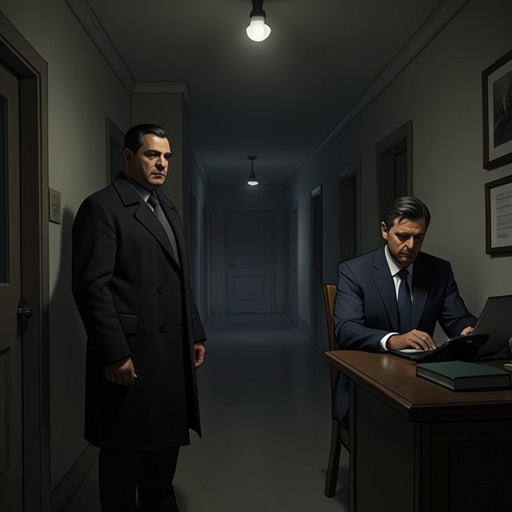
Creasy captures and interrogates Giorgio Rabbia
Man on FireCreasy’s capture of Giorgio Rabbia turns the former kidnapper into a prisoner and source of information about the Balletto kidnapping. By identifying Rabbia, controlling the journey, and bringing him to an isolated house, Creasy shifts the encounter from a street-side ambush to a deliberate interrogation.
Capture and Transfer
After leaving the street, Rabbia gets into his Lancia, unaware that the head of a dachshund in the car is bobbing gently. As he reaches for the ignition, a gun presses against the back of his neck and a voice orders him not to move. Rabbia asks whether the stranger knows who he is; the answer names him and warns him not to speak again. The stranger removes Rabbia’s gun and directs him to drive slowly, without attracting attention. Rabbia considers possible explanations, including trouble with the Abrata group and resentment from the Union Corse, but cannot identify his captor. The route leads south, past the outskirts of the city and onward toward Vigentino, then down a side road and dirt track to a low bungalow of the kind wealthy Milanese use for weekends. When Rabbia stops and switches off the engine, the pressure of the gun disappears; a blow leaves him unconscious. He wakes with both wrists taped to a chair and sees a table laid out with objects that make the captor’s purpose unmistakable: a hammer, steel spikes, a large knife, and an electrically powered soldering iron. Across from him sits the man who has brought him there.
Interrogation and Disclosure
Creasy makes the terms of the questioning plain: Rabbia must answer fully and truthfully or face escalating physical punishment. Rabbia initially curses and resists, but Creasy’s deliberate violence breaks that resistance. After Rabbia asks what his captor wants, Creasy opens a notebook and begins with the Balletto kidnapping. The questioning lasts more than an hour. Rabbia hesitates only when the subject turns to Fossella; when Creasy prepares to resume the threat, the answers begin again. The notebook gives the scene a grimly methodical shape: Creasy is not acting at random, but extracting names, actions, and connections.
Rabbia identifies himself as the driver in the abduction and says Sandri shot Creasy during the attempted kidnapping. The other dead participants were Dorigo and Cremasco. Rabbia says the group had been told to collect Pinta at a specified time and place and take her to a house in Niguada. Fossella had assured them that her bodyguard would pose little difficulty, and Dorigo was instructed to fire shots to frighten him away; Rabbia concedes that the plan had been careless. He knows nothing about the ransom money itself, separating the men who carried out the abduction from whoever controlled its finances.
The interrogation also exposes the abuse Pinta suffered in captivity. Rabbia names Sandri as her first assailant, explaining that Sandri was angry because Dorigo had been his friend and because Pinta had fought back. Asked directly whether he too assaulted her, Rabbia eventually admits that he did, and says that he and the others were left with her for more than two weeks while ransom trouble delayed the operation. His explanation that there was little else to do, and that Pinta was beautiful, presents their cruelty as casual entitlement rather than necessity. Creasy’s controlled questioning makes the admission part of the operational record, but the facts also reveal the violence concealed behind the kidnappers’ failed plan.
Rabbia says Fossella was angry about Pinta’s death because it was a mistake and because the kidnappers had expected to receive ten million lire each. They received nothing. Rabbia adds that Sandri was fortunate to be Fossella’s nephew, suggesting that kinship protected him from consequences that the others might otherwise have faced. Creasy then turns to Sandri’s friends, movements, and habits, before questioning Rabbia in the same way about Fossella. The encounter thus yields more than a confession about the abduction: it gives Creasy leads for pursuing both the direct perpetrators and the organization behind them.
The Fatal Outcome and the Limits of the Confession
Rabbia’s account of the kidnapping sits beside the explanation Guido gives Creasy for Pinta’s death: the ransom had been paid two days earlier, and she was supposed to be released that night, but she did not appear. A police sweep targeting a Red Brigades gang had made the kidnappers nervous; they went to ground for several hours. Pinta, taped at the hands and mouth and left in the trunk of a stolen car, vomited, probably from petrol fumes, and choked to death. The discrepancy between the kidnappers’ expectation of a short operation and the more than two weeks Rabbia says they held her helps explain the immediate circumstances, but it does not lessen their responsibility for keeping her captive and abusing her.
The questioning distinguishes what Rabbia knows from what remains beyond his account. He names the men involved, describes the plan and its failures, and identifies Sandri and Fossella as leads, but says he knows nothing about the ransom money itself. His admission that Fossella called Pinta’s death a mistake reveals the kidnappers’ concern with the failed operation and lost payment; Rabbia’s statement that Sandri was Fossella’s nephew also exposes a family tie within the criminal chain. Creasy leaves the bungalow with names, movements, and relationships to pursue, while the interrogation’s careful accumulation of detail makes clear that extracting information is not the same as accounting for every part of the crime.
Tactical Reversal and Narrative Function
The capture reverses the logic of Creasy’s original assignment. When hired to protect Pinta, he treated her as an asset vulnerable at home, at school, or along a familiar route; at the school, he inspected the spike-topped walls, gates, and grounds, and from the car he studied the road for places an attacker might exploit. The kidnapping had exposed the limits of protection: Pinta was taken in the open, while Creasy hesitated to shoot because she stood between him and the armed men. In Rabbia’s capture, Creasy instead controls the route, the timing, and the conditions of the encounter, turning the skills first used defensively into instruments of pursuit.
Rabbia’s guesses about who has taken him—first a rival criminal group, then possible Corsican enemies—show how little he understands the force now confronting him. He has built his expectations around the rivalries and reprisals of organized crime; the captor’s questions redirect those expectations toward Pinta and the men responsible for her abduction. When Creasy names the Balletto kidnapping, Rabbia recognizes his face. The recognition makes the interrogation a delayed continuation of the original attack: the bodyguard who could not prevent Pinta’s removal has returned to demand an account from one of its participants.
The notebook and the hour-long sequence of questions give the encounter a second, investigative purpose. Creasy seeks not only an admission of Rabbia’s own part but a usable map of the operation: who drove, who fired, where Pinta was held, who directed the job, and what connections might lead onward. Rabbia’s information remains partial—he disclaims knowledge of the ransom money—but it identifies people and relationships for Creasy to pursue. The scene therefore converts private grief into a chain of inquiries, while its controlled, procedural progression contrasts with the kidnappers’ carelessness and the disastrous consequences of their plan.